
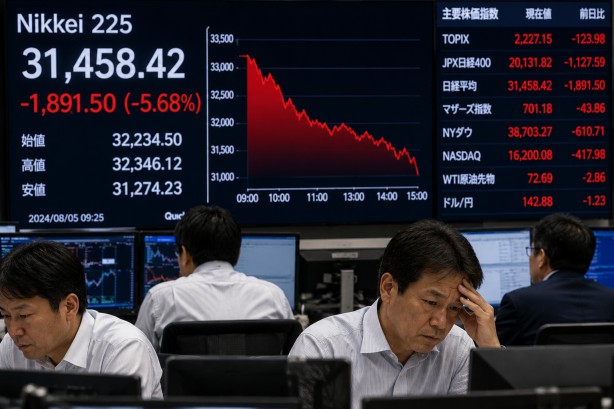
Asian stock markets experienced significant declines on Friday, driven largely by a sharp drop in Japan’s Nikkei 225 index. The index plummeted 5.8%, falling below the 63,000 mark due to heavy selling in technology and artificial intelligence-related stocks, which unsettled investors. Other markets in the region followed suit, with Taiwan’s stock market losing over 5%, Hong Kong’s Hang Seng index decreasing by 2%, and the Shanghai Composite in China dropping 1.6%. Australia’s S&P/ASX 200 also saw a decline, slipping by 0.7%.
The pressure on technology stocks has been mounting in recent weeks, as concerns grow that valuations in the artificial intelligence sector may have escalated too swiftly. This has led investors to question whether the demand for advanced chips and memory products will sustain if artificial intelligence does not deliver the anticipated profits and productivity gains. Such apprehensions have contributed to the widespread sell-off observed in these markets.
In the United States, similar trends were evident as the Nasdaq Composite fell by 1.5% on Thursday. This decline was largely driven by losses in major chipmaking companies. Among them, Nvidia saw its shares drop by 2.4%, while Micron Technology, SanDisk, and Western Digital also experienced significant downturns.
Amid these developments in the stock markets, oil prices were on the rise due to escalating tensions in the Middle East. Concerns about potential disruptions to global energy supplies passing through the Strait of Hormuz contributed to this increase. Brent crude prices rose by 1.1%, reaching $85.13 per barrel, while the US benchmark crude gained 1.3%, climbing to $79.95 per barrel.