
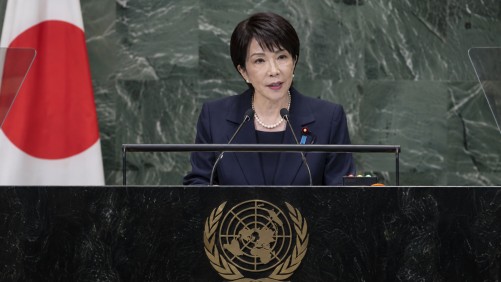
Japan’s renewed commitment to supporting the International Criminal Court (ICC) and advocating for the rule of law could bolster global efforts toward an open international order. Prime Minister Sanae Takaichi’s address to the United Nations General Assembly underscored Japan’s dedication to upholding international legal frameworks, a stance that might influence other nations to strengthen their own commitments.
During her first UN General Assembly address since assuming office, Takaichi emphasized the importance of the United Nations in maintaining global peace and stability, especially as the geopolitical climate has shifted since the end of the Cold War. She advocated for reforms within the UN and its Security Council to better reflect the diverse makeup of the international community.
Highlighting Japan’s historical support for international judicial institutions, Takaichi reiterated the country’s backing of the ICC. Her remarks, however, did not specifically address the U.S. sanctions imposed on ICC President Tomoko Akane, who is of Japanese nationality. This omission leaves some questions about Japan’s stance on the matter.
Beyond legal frameworks, Takaichi addressed pressing global security concerns, notably condemning Russia’s military actions in Ukraine, which she described as unacceptable unilateral attempts to alter the status quo by force. She also called for a coordinated international response to North Korea’s ongoing nuclear and missile program developments, while expressing Japan’s openness to dialogue regarding the abduction of Japanese citizens by North Korea.
On economic fronts, Takaichi stressed the significance of energy security, announcing Japan’s plans to work closely with Gulf nations to secure stable energy supplies amidst global disruptions. She encouraged international cooperation in managing critical resources and advancing artificial intelligence technologies, which are seen as pivotal for future economic resilience.